Jul 19, 2011

Kitaeji Maintenance 4

Here I want to show how Kitaeji react to synthetic stone.
I used my Arashiyama and polished the tip part of the Kitaeji.


I did not sharpen the edge. I just polished the Kitaeji because I wanted to know how the finish is.
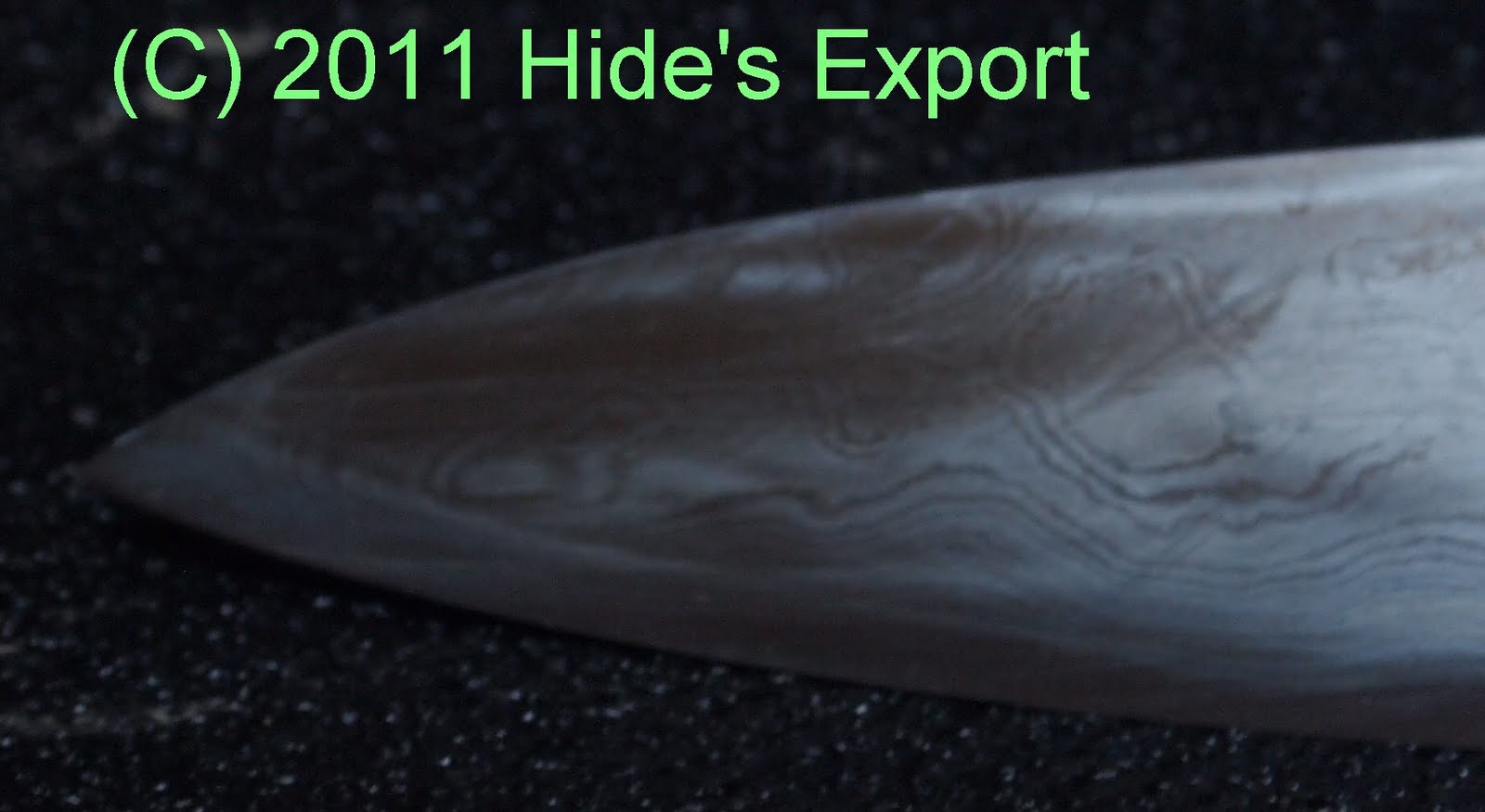
Here are the results:


The Kitaeji patterns are gone where the stone polished the Kitaeji.
Before I used my fingerstone I wanted to know how Bar Keepers Friend (BKF) react to the worn Kitaeji. BKF was the only polish agent which was indifferent to Kitaeji patterns as you can see here:  Kitaeji Maintenance 2

Here the result:

  Some of the Kitaeji patterns are back but the contrast is very little.

 I used my Hakka fingerstone and in 1 min I had the Kitaeji patterns back.
Excuse me of the few scratches (you can see then if you click in the picture for full scale). I was in hurry and did not care about contamination.

Conclusion: 
From the 4 polishing agents only BKF is indifferent to Kitaeji patterns. 
Though weak BKF can get some Kitaeji patterns back. 
Synthetic Stone (Arashiyama) will destroy the Kitaeji pattern. 
But you can sharpen with synthetic stone and get the Kitaeji pattern back with Japanese Natural fingerstones.

Jul 17, 2011

Kitaeji Maintenace 3

Continued from Kitaeji Maintenance 2.

Case 3 Pikal:

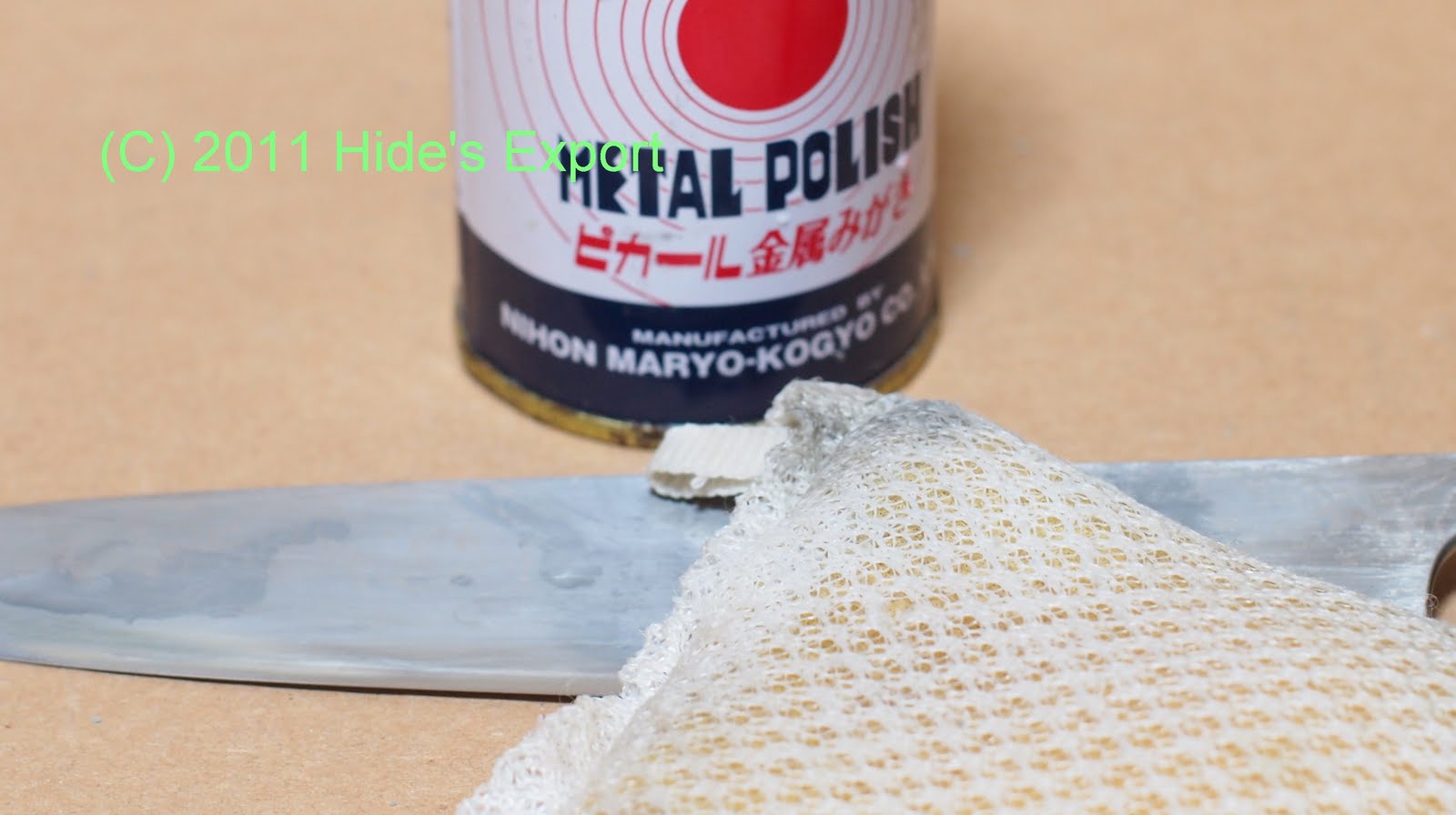
Pikal is a polisher which is used in Japan.


I applied this polish at a part of the knife with a kitchen sponge.

1 min of polish and the Kitaeji pattern is almost gone.

Now maintenance with the Maruka fingerstone:

With experience I got better with the water/mud ratio. You will see it is almost all swarf and little mud.
After 1 or 2min the Kitaeji pattern is back:


Case 4 Chromium(III) oxide (Cr2O3):

This polisher is sold in Japan as "Aobo" which means blue stick.

Arrow is just indicating shadow of the "Aobo"

Cr2O3 polish with tissue paper


The Cr2O3 polish was quite slow. It took me 5 min and still the Kitaeji pattern was still visible.
I used the Hakka fingerstone to regain the Kitaeji pattern and the result is here:


Conclusion.

Polishing the Kitaeji with polishing agent which make mirror finish to soft iron will destroy the Kitaeji pattern.
I think some synthetic finishing stones does it too. (I did not do the test because I do not have fingerstones from synthetic finisher).

Regaining of the Kitaeji pattern is very easy with high grade natural fingerstones.

The contrast of the Kitaeji was:
Hakka>Maruka>Uchigomori

The uniformity of the finish was Uchigomori=Maruka>Hakka

I have tested more than 10 other natural fingerstones which I did not make any pictures. The 3 fingerstones in this test are the best 3 of the fingerstones I have tested so far.

These 3 fingerstones can be used to the Kasumi finish too to make nice haze.

Kitaeji Maintenance 2

What I did is polish part of my Kitaeji 180mm Petite with some polish.
These polish make mirror finish to very soft iron so in most cases the Kitaeji patterns are gone.

After the polish I used one or 2 of the finger stones and brought the Kitaeji pattern back.

Case 1 Mothers Mag & Aluminum Polish


You can see after the Mothers polish the Kitaeji pattern is gone.

Now I want to have the Kitaeji pattern back.
I used Uchigomori fingerstone with some water.


The mud or swarf is a bit thin for this Uchigomori finger stone. Swarf/mud ratio is high and indicate that this stone is a real "Sword Polish Grade" Uchigomori. In 1 or 2 min the Kitaeji pattern is back. But the contrast of the pattern is not so high.

Next I tried Hakka fingerstone:


The Hakka fingerstone makes much more mud.  After 1 minute or so I got much more contrast. With more contrast you get also the wide or broad lines.

Case 2 BKF:

I polished with BKF only 1 min or 2 min. The time maybe to short for the acid of BKF to react full with the steel. But still you can see that the Kitaeji got a bit brighter.

I used a Maruka fingerstone with water to eliminate the bright side caused with BKF.


I used the fingerstone for 1 to 2min. 
This Maruka fingerstone is the best of all 3 fingerstones in this test. It has high swarf/mud ratio and is very fast.


 The contrast of the Kitaeji pattern is in the middle of Hakka and Uchigomori.

More tests in part 3

Kitaeji Maintenance 1

 The maintenance of Kitaeji is very easy using Japanese natural finger stones.
I will write about it in part 2.

First some pictures of out of the box (OOTB) Kitaeji:

Kitaeji Gyuto 240mm

Kitaeji Santoku 180mm

Another Kitaeji Gyuto 240mm
The Kitaeji is made by carbon steel and very soft iron. You can read about it here:  Q&A with Iizuka san


 The patterns of Kitaeji carbon steel (see arrow) can be white or black. 
 It will depend on light. Carbon steel is more like a mirror and very soft iron has haze. If the blade reflect the light direct the carbon steel is white (white arrow). If it does not reflect the light direct the haze of very soft iron reflect more light and get brighter than the carbon steel (black arrow). 

 Kitaeji has also very narrow "hairlines".
 I do not know if I can show you it in this picture:

"Hairline" Kitaeji
It is the same "hairline the Kasumi finish has:

"Hairline" Kasumi
 You can see it much better in the Kasumi finish picture. But if you have the knife at hand you can feel the "hairlines" with finger or nail.

  Iizuka san does not tell me how he makes these hairline finish by hand. I think it is secrect.

  Other blacksmith who use machines make such hairlines with rotating steel brush. I do not have such machine so I will skip to make these hairlines.
  There are also some broader lines OOTB.

Broad Lines
 There are some broad lines which I indicated with white arrow. Iizuka san said these are "characters" of Kitaeji. The reason of these lines are not clear. Uneven diffusion of carbon from carbon steel to soft iron or uneven distribution of boric acid powder can be the cause.

I tested 3 different finger stones.

Here the pictures of stones I made the finger stones:

Ohira Uchigomori Suita Sword Polish Grade

Nakayama (Maruka) Stone (a bit more orange than egg color)

Hakka (Finer an a bit harder than usual Hakka)
 Picture of the finger stones (Uchigomori and Hakka)

Left Hakka and right Uchigomori finger stones.

Continued to part 2

Jul 8, 2011

Shigefusa is Rebuilding HT Forge

I got news that Shigefusa workshop is rebuilding the heat treatment (HT) forge.
I think many of my readers know that the Shigefusa workshop has been flooded July 2004 because the dike of river Igarashi got broken by very heavy rain.

You can read about it here (in Japanese with map):
http://www.gsi.go.jp/WNEW/koohou/436-5.htm


Shigefusa used the old flooded HT place but after years wood got bad etc so he started to rebuild it this summer.
It is almost ready now.

Shigefusa was not able to make HT for a week or two.
It may delay the waiting time for some knives of my customers but as of now I have no news about delay from Shigefusa.

Jul 5, 2011

Yoshihide SKD 240mm Migaki Gyuto

Yoshihide SKD 240mm Migaki Gyuto is one of the best sellers I get orders.
It happened that Yoshida san made 1 too many.
So I got it and it is ready to ship to the lucky customer who do not want to wait 1 month.

See pictures and if you  want it agree to terms and conditions and send me an e-mail.

The blade length is 242mm and height at heel is 48mm.
Weight is 180g.


Jul 3, 2011

More Knife Pictures (2)

Here some more pictures of kitchen knives made by Shigefusa and Yoshikane.
They are ready to ship or recently shipped.

Shigefusa:


Shigefusa 180mm Kitaeji Santoku Wa Handle


Shigefusa 240mm Kasumi Gyuto Wa Handle


 Yoshikane:


Yoshihide Special Order Kurouchi Chopper

Read here about this Chopper The Story of the Chopper.


Yoshihide 240mm SKD Migaki Gyuto Wa Handle with Saya


Yoshihide 240mm SKD Migaki Gyuto Wa Handle


Yoshihide 80mm SKD Migaki Petite


Yoshihide 80mm SLD KU Sekiso Paring Knife Western Handle
 This is  a small knife but lot of craftsmanship in it.

 I hope all these knives will have a nice home soon.